
In partnership with

$6B Stolen, Oil Spiked, $80K Snapped.

The FBI says North Korea stole more than $6B from Binance.
Crypto just went from checking the receipt to checking every lock in the restaurant. Exchange trust now has a live scoreboard—recovery, customer protection, withdrawals, and wallet activity—while Brent at $113.43 and the 10-year yield at 4.929% make the macro menu expensive. BTC preserved a crucial trend cluster but lost $80K; ETH broke with heavier participation. The next course is JOLTS, payrolls, and election results, so this is no week to confuse “still standing” with “repaired.”
Today’s Sponsor: Fintech Takess

If you work in fintech or finance, you already have too many tabs open and not enough time.
Fintech Takes is the free newsletter senior leaders actually read. Each week, I break down the trends, deals, and regulatory moves shaping the industry — and explain why they matter — in plain English.
No filler, no PR spin, and no “insights” you already saw on LinkedIn eight times this week. Just clear analysis and the occasional bad joke to make it go down easier.
Get context you can actually use. Subscribe free and see what’s coming before everyone else.
WEEKLY MAP
Weekly Map
BTC 4H — The $80K Repair Test

BTC swept its deeper trend cluster and recovered, but the 4-hour structure still needs $80,000 back before the repair earns a clean bill of health.
What Moved: The FBI attributed the more-than-$6B Binance theft to North Korea, turning an exchange loss into a state-security and confidence story. Meanwhile, BTC finished the active weekly read down 2.88%, ETH fell 3.06%, and DXY added only 0.18%.
What Matters: Recovery quality is uneven. BTC bounced after sweeping its weekly EMA20/daily EMA200 cluster, while ETH remains below every tracked EMA after a breakdown on 22.85% above-average weekly volume. That is one plate patched and another still cracked..
This Week's Job
Separate containment from recovery. Watch verified exchange updates, then judge the tape by acceptance—not the first spicy candle served after a headline.
QUICK REFERENCE
Cheat Sheet
BTC — $77,829.19 (-2.88% weekly)
Resistance: $80,000 (first repair) / $82,000 (upper repair gate)
Bias: Bearish — 76% conviction
Key tell: Holding the recovered trend cluster keeps stabilization alive. Reclaiming $80K upgrades the meal from leftovers to something worth ordering again.
ETH — $2,259.77 (-3.06% weekly)
Support: $2,250 (thin hold) / $2,175 (decisive floor)
Resistance: $2,320 (stabilization test) / $2,400 (structural repair)
Bias: Bearish — 82% conviction
Key tell: $2,320 is the first proof that the rebound has substance. Below it, the higher-participation breakdown still owns the table.
DXY — 101.964 (+0.18% weekly)
Support: 101.75 (reclaimed support) / 101.50 (range floor)
Resistance: 102.20 (range ceiling) / 103.00 (breakout gate)
Bias: Neutral — 64% conviction
Key tell: A move outside 101.50-102.20 matters more than every wiggle inside it. Until then, the dollar is background pressure, not the entire recipe.
⛔ Invalidation: BTC below $76,000, ETH below $2,175, and DXY above 102.20 would turn fragile stabilization into a broader risk-off confirmation.
MACRO CONTEXT
Zooming Out
Oil Put Inflation Back on the Front Burner
Brent closed at $113.43 after oil rose about 2% following renewed Strait of Hormuz tanker incidents. The exact physical disruption remains the question, but the market consequence is already visible: triple-digit oil keeps the inflation conversation loud before a labor-heavy week.
Brent: $113.43 at the latest close
US10Y: 4.929%, one small step from the 5% stress line
DXY: 101.964, still below 103 but structurally firm inside its range
This combination is awkward for risk assets. A softer dollar usually helps, but expensive energy and near-5% yields can keep financial conditions tight enough that crypto still has to cook without the usual macro tailwind.
Oil is the ingredient that can keep the rates kitchen hot. The key read is whether yields accept above 5%, not whether one headline creates a dramatic intraday wick.
Exchange Trust Became the Crypto Regime Check
The Binance theft changed categories when the FBI attributed the October 29 theft of more than $6B to North Korea. The next chapter is measurable, which is refreshing in a market that usually serves rumor soup.
Watch for verified updates on asset recovery and frozen addresses.
Watch for evidence on customer-loss replacement and withdrawal normalization.
Watch the next full week of institutional flows for evidence that demand is returning.
A reported $643.2M left U.S. spot BTC ETFs on October 30, according to Decrypt, ending four reported inflow sessions. One attributed session is a warning, not a verdict; the useful question is whether the institutional floor reloads or keeps thinning.
Trust is now a market variable, not a branding slogan. The exchange story improves when the evidence improves—anything else is garnish.
Payroll Week Has No Quiet Corner
The official calendar runs from JOLTS on November 3 through trade data, productivity and costs, and payrolls on November 6. There is no FOMC decision in this window, but with the 10-year already at 4.929%, the bond market can make plenty of noise without Powell taking the microphone.
Nov. 3: JOLTS and U.S. midterm election outcomes
Nov. 4: International trade in goods and services
Nov. 5: Preliminary Q3 productivity and costs
Nov. 6: October payrolls
Election results add a second Tuesday scoreboard. Chamber control and committee leadership can reshape the path for market-structure, stablecoin, exchange, and enforcement policy; the votes have to land before anyone starts plating a legislative victory lap.
The macro job is simple: watch the yield reaction. A number is trivia until the bond market tells you what it costs.
TECHNICAL ANALYSIS
Locking In: BTC
BTC 1D — Trend Cluster Saved, Repair Incomplete

BTC recovered the weekly EMA20/daily EMA200 cluster after a sweep, but price remains south of the daily EMA20/50 and the first $80,000 repair level.
Weekly tape: -2.88% (O $80,139.38 | H $81,971.18 | L $76,326.22 | Latest $77,829.19)
Bias: Bearish — 76% conviction
Since last week, $80,000 support failed and the old $79,200 base gave way. The important part is what happened next: price swept the weekly EMA20/daily EMA200 cluster and recovered it, preserving the larger structure without fixing the short-term damage.
Participation keeps the read honest. Active weekly volume ran 12.75% lighter than its trailing 20-week average, so neither the selloff nor the rebound arrived with an army behind it. The 4-hour MACD turned positive, but price still sits south of the full 4-hour EMA stack—an appetizer, not a feast.
Key Levels:
Support: $77,000
Line in the Sand: $76,000
Trigger Resistance: $80,000
Major Overhead: $82,000
Scenario Map:
Base (43%): A $76K-$77K floor, an $80K cap, and range digestion while trust and macro catalysts get priced.
Bull (20%): $80K recovery followed by $82K, converting the trend-cluster save into actual repair.
Trap (37%): Weekly acceptance south of $76K turns the late rebound into a failed defense.
Conviction driver: The decisive clue is acceptance around the recovered trend cluster. A few green candles are table decorations; sustained trade through $80K is the first evidence the kitchen has fixed the main course.
Quick tips: Do not chase the first post-headline candle. Let $77K show whether demand appears, and treat $80K as a confirmation test rather than a prediction.
TECHNICAL ANALYSIS
Locking In: ETH
ETH 1D — Heavy Breakdown, Thin Rebound

ETH remains below every tracked weekly, daily, and 4-hour EMA after a breakdown that carried stronger-than-average weekly participation.
Weekly tape: -3.06% (O $2,331.00 | H $2,391.40 | L $2,174.69 | Latest $2,259.77)
Bias: Bearish — 82% conviction
Since last week, $2,350 support and the $2,280 base both failed. The rebound from $2,174.69 recovered $2,250, but it did not recover even the 4-hour EMA20. That is stabilization by a whisker, not trend repair.
The volume contrast with BTC is the headline inside the chart. ETH's active weekly volume ran 22.85% above its trailing 20-week average, meaning the breakdown had real participation. Daily RSI at 32.50 shows weak momentum; a positive 4-hour MACD histogram says downside speed eased, not that dinner has been rescued.
Key Levels:
Support (Must-Hold): $2,250
Line in the Sand: $2,175
Trigger Resistance: $2,320
Major Overhead: $2,400
Scenario Map:
Base (39%): A $2,175-$2,250 floor with $2,320 still acting as the cap.
Bull (13%): $2,320 recovery and a $2,400 retest; sustained trade north of $2,400 materially repairs the chart.
Trap (48%): Weekly acceptance south of $2,175 extends the participation-backed breakdown.
Conviction driver: ETH is the cleanest stress gauge in the core trio. If $2,320 remains out of reach while volume stays elevated, the rebound is cold leftovers with a nice garnish.
Quick tips: Respect $2,175 as the hard risk line. If $2,320 is reclaimed, wait for it to hold; one wick above a trend filter is not a reservation confirmation.
MACRO ANALYSIS
Locking In: DXY
DXY 1W — Two-Sided Sweep, No Verdict

DXY swept below support and above resistance before finishing back inside its established decision range.
Weekly tape: +0.18% (O 101.780 | H 102.490 | L 101.540 | Latest 101.964)
Bias: Neutral — 64% conviction
Since last week, the lower range edge tightened from 101.45 to 101.50 after the weekly low printed 101.540. DXY recovered 101.75, rejected the move through 102.20, and finished back inside the same range. In restaurant terms: the dollar sampled both specials and ordered neither.
It remains above every tracked weekly and daily EMA, so “range-bound” should not be confused with “weak.” Positive weekly momentum and cooling daily momentum support consolidation until price accepts outside the box.
Key Levels:
Support (Floor): 101.75
Pivot Level: 101.50
Resistance (Ceiling): 102.20
Break Level: 103.00
Scenario Map:
Base (50%): A 101.50-101.75 floor with 102.20 acting as the cap.
Bull-Dollar (30%): Sustained trade north of 102.20 and a 103.00 retest.
Bear-Dollar (20%): Sustained trade south of 101.50 and rotation toward the weekly EMA200 near 100.82.
Crypto Translation
A DXY break south of 101.50 would improve the room for BTC and ETH to repair, but it would not fix their charts by itself. A move north of 102.20 would make every crypto recovery more expensive; through 103, the macro tab gets noticeably uglier.
What it means for crypto: Dollar relief is helpful only if BTC regains $80K and ETH regains $2,320. Otherwise, the market is wasting a favorable ingredient.
What breaks the DXY setup: Weekly acceptance south of 101.50 softens the firm-dollar read; acceptance north of 102.20 restores immediate upside pressure.
For the week: Stop reacting to every intra-range twitch. The useful signal comes when price leaves 101.50-102.20 and stays out.
MARKET INTELLIGENCE
Top Stories
SECURITY / EXCHANGE
🕵️ THE $6B LOCK CHECK
The FBI attributed the October 29 theft of more than $6B in virtual assets from Binance to North Korea. That moves the story beyond one exchange balance sheet and into sanctions, state-backed cybercrime, wallet surveillance, and industry-wide trust—the kind of entrée nobody ordered but everyone has to digest.
Why it matters: Exchange confidence now depends on visible evidence, not reassurance. Recovery progress, customer protection, liabilities, and normal withdrawals are the scoreboard.
What to watch: Verified updates on frozen addresses, recovered assets, customer-loss replacement, withdrawal normalization, and proof-of-reserves/liabilities.
FLOWS / INSTITUTIONS
🏦 THE DIP-BUYERS MISSED A SHIFT
Decrypt reported $643.2M in U.S. spot BTC ETF outflows on October 30, ending four reported inflow sessions. One session cannot settle the institutional-demand debate, but it does show the first serving of weakness was not automatically devoured.
Why it matters: The cautious-bullish thesis needs persistent demand, not a logo-filled list of ETF products. A single outflow is a warning; a sustained pattern would be a regime problem.
What to watch: The next full week's net flow and whether demand returns while BTC tests $76K-$80K.
CALENDAR / RATES
⏰ FOUR PRINTS, ONE BOND-MARKET BILL
The official November calendar serves JOLTS on Tuesday, trade on Wednesday, productivity and costs on Thursday, then payrolls on Friday. With the 10-year at 4.929%, even modest surprises can matter because the market is already seated beside the 5% fire alarm.
Why it matters: Yields decide how expensive the next crypto repair attempt becomes. The sequence matters more than pretending one print comes with a prewritten direction.
What to watch: Whether the 10-year rejects 5% or begins accepting above it as the data arrives.
POLICY / ELECTIONS
🗳️ CRYPTO'S WASHINGTON TABLE GETS RESEATED
Tuesday's U.S. midterm elections can change congressional control and committee leadership, putting market structure, stablecoins, exchange oversight, and enforcement priorities back in play. The races to watch matter because personnel often determines which bills get a chair and which stay in the freezer.
Why it matters: Policy pathways can shift even when no law changes overnight. Oversight tone and committee agendas are part of crypto's operating environment.
What to watch: Actual outcomes, confirmed leadership changes, and the first concrete legislative priorities—not victory-lap speculation.
SUPPORTING CHARTS
Chart Buffet
OIL 1D — Triple-Digit Inflation Pressure

Brent at $113.43 keeps energy costs on the front burner and turns every labor print into a rates sensitivity test. If triple digits persist, the macro kitchen stays hot even without a fresh escalation headline.
GOLD 1D — Hedge Demand Reality Check

Gold shows whether demand for geopolitical and inflation protection is broadening beyond oil. Think of it as the second thermometer: useful confirmation if it heats up, useful skepticism if the hedge bid stays narrow.
US10Y 1D — The 5% Cost-of-Capital Test

The 10-year finished at 4.929%, leaving 5% close enough to smell from the dining room. A rejection would ease the bill for risk assets; acceptance above it would make crypto repair compete with an even more attractive bond yield.
FURTHER READING
Key Reads
The primary attribution and address-level enforcement context.
A concise account of the state-actor finding and the exchange-security stakes.
The clearest explanation of this week's oil reaction and macro pressure.
The races and policy stakes worth tracking as results land.
Reader-friendly context for the reported October 30 ETF outflow.
CLOSING THOUGHTS
Last Bite — Macro Pulse Check
BTC 1W — Bigger Trend Alive, Weekly Repair Denied
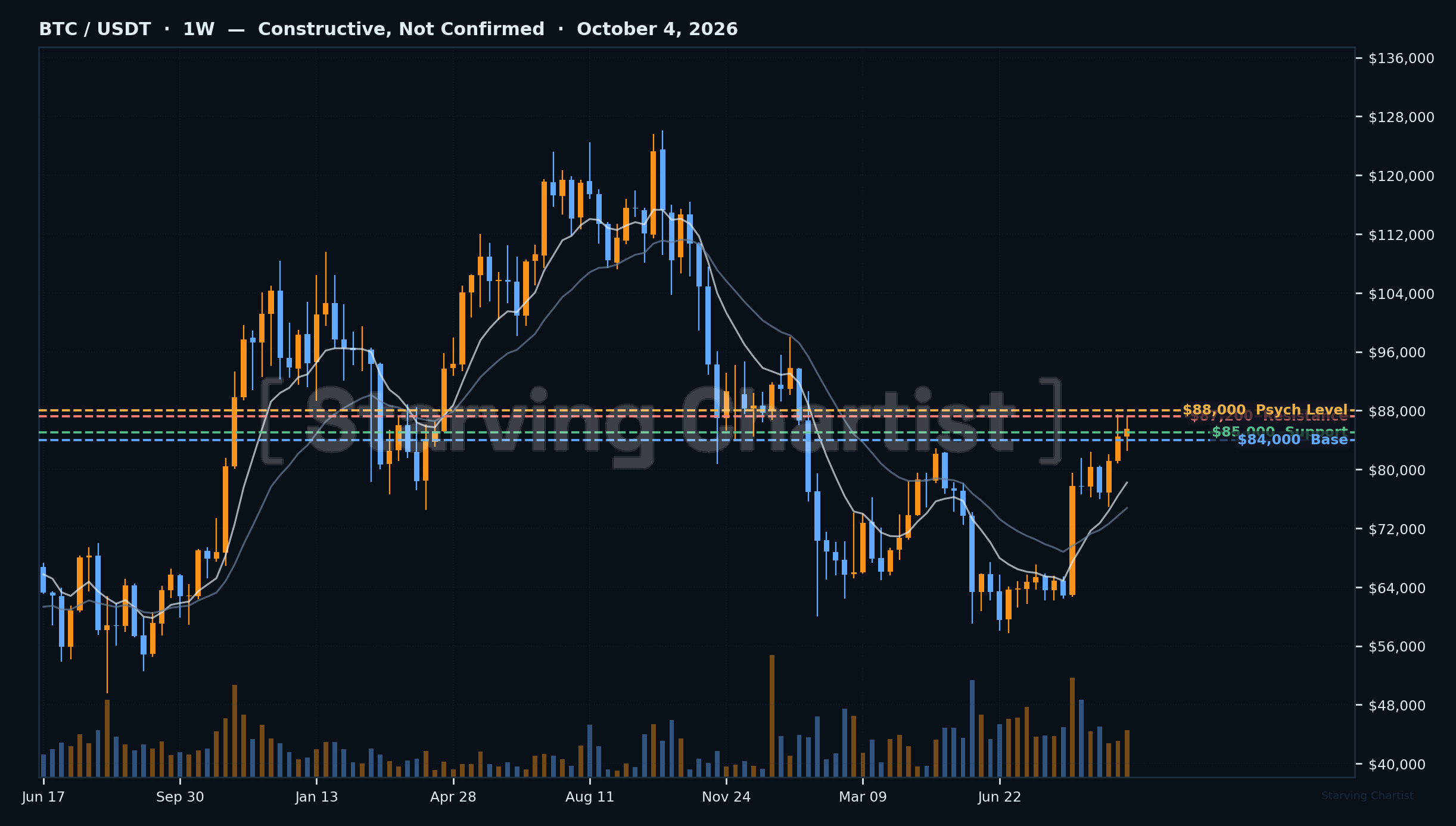
BTC preserved the weekly EMA20/daily EMA200 cluster, but the loss of $80,000 keeps the near-term structure in repair mode.
This week did not kill the bigger cautious-bullish thesis, but it absolutely lowered the table's hygiene score. BTC remains above the standing $76,000 monthly validation area and DXY remains below 103, so the structural case survives. The near-term evidence is worse: $80K failed, ETH broke with stronger participation, oil is above $113, and the 10-year is knocking on 5%.
Conviction in the immediate weekly setup is bearish at 78%, while conviction in the longer repair thesis stays conditional rather than canceled. That distinction matters. A living thesis can survive a bad week; a good trader still adjusts when the ingredients deteriorate.
The one macro thing to watch is whether the 10-year accepts above 5% through the labor-data sequence. A rejection would give crypto breathing room, especially if exchange-trust evidence improves. Acceptance above 5% would leave the kitchen serving expensive capital beside a confidence problem—and that is a pairing nobody should order twice.
what should we serve more of?
how was your meal?
NFA as always — Stay Fed. 🦞
Starving Chartist · Main Course · Premium · October 4, 2026
